Robots that move among people
My PhD research follows the data through a mobile robot: from raw sensor readings to a map, from the map to an understanding of the people in it, and from there to motion that people find acceptable. Everything is tested on a PAL Robotics TIAGo with ROS 2 and Nav2.
- 1SenseMulti-sensor fusion for 2D mapping
- 2MapVisual SLAM in dynamic scenes
- 3UnderstandHuman action, trajectory and engagement
- 4NavigateSocially-aware navigation
- 5ReasonLLMs for robot task control
1Sense
Fusing cameras and LiDAR into one reliable scan
A 2D LiDAR sees a single slice of the room. It misses table tops, chair legs and anything above or below its plane. I project the point clouds of four RGB-D cameras into that plane, filter the noise and merge them with two LiDAR scans. The mapping algorithm, Enhanced Gmapping (EGM), adds adaptive particle resampling and handles the cases where a particle filter normally degenerates.
Localisation drift fell from 1.56 m to 0.85 m and the robot reached 95 % of its goals indoors.
Papers
2Map
Keeping the map correct while the scene moves
Classic visual SLAM assumes a static world. When a person walks through the image, features on that person drag the estimated camera pose with them. SAR-SLAM segments likely movers with YOLOv8, checks with a RANSAC homography whether they are really moving, and fuses both answers before features reach ORB-SLAM3. A person standing still keeps their features; a walking person loses them. It plugs in without changing the ORB-SLAM3 code.
Up to 96 % lower absolute trajectory error than ORB-SLAM3, and best or joint-best on all eight TUM RGB-D sequences tested.
Papers
- SAR-SLAM: Semantic-Aware Recognition for Dynamic SLAM in Robotic Applications Robotics, 2026
- A Review of Visual SLAM for Robotics: Evolution, Properties, and Future Applications Frontiers in Robotics and AI, 2024
3Understand
Recognising what people do and where they will go
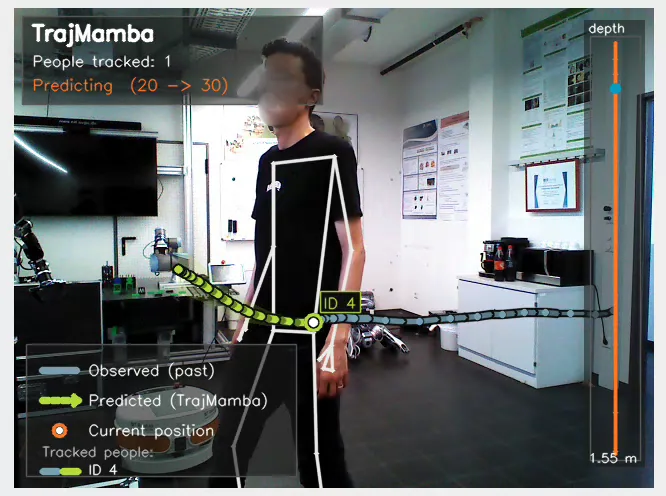
A robot that shares space with people needs to know more than where they are. I work on three signals. Action recognition tells the robot what a person is doing, with models small enough for an embedded GPU. Trajectory prediction with TrajMamba, a 262 K-parameter bidirectional Mamba model, estimates the next three seconds of a person’s path from RGB-D. Engagement and gaze estimation, with colleagues, tell the robot whether someone wants to interact at all.
96.6 % accuracy on UCF-101, and REMA-Net reaches 96.8 % at 11.82 ms per inference on a Jetson Nano.
Papers
- Multi-Head Attention-Based Framework with Residual Network for Human Action Recognition Sensors, 2025
- REMA-Net: Real-Time Human Action Recognition via Caption-Guided Dual-Stream Attention SSRN preprint, 2026
- Eye Contact Based Engagement Prediction for Efficient Human–Robot Interaction Complex & Intelligent Systems, 2025
- Deep Learning-Based Gaze Estimation: A Review Robotics, 2026
- Joint Estimation of Affective and Attentional States from Egocentric Video Input for Human-Robot Interaction Submitted to a Springer Nature journal
Code
5Reason
Letting language models decide what to do next
With colleagues I studied how large language models can be wired into a robot: open-loop, where the model writes a plan once; closed-loop, where it sees the result of each step; and fully LLM-driven control. We tested the taxonomy on TIAGo and in simulation with GPT-4 and Vicuna.
Closed-loop systems handled unexpected situations effectively, with human-like problem solving.
Papers
- Toward Truly Intelligent Autonomous Systems: A Taxonomy of LLM Integration for Everyday Automation Robotics, Computer Vision and Intelligent Systems (ROBOVIS 2025), 2025
Platform and funding
All methods are validated in simulation and on real hardware: a PAL Robotics TIAGo with ROS 2 Humble and Nav2, and Jetson Nano and Orin boards. The work is supervised by Prof. Dr. Ayoub Al-Hamadi in the Neuro-Information Technology (NIT) group and has been funded through these projects.
- BMBF AutoKoWAT-3DMAt
- DFG SEMIAC
- EFRE ENABLING
- EFRE RoboLab
- BMFTR Edison
- ERDF ORAKEL